Ortica Street Art Tour Through Milan's Memory
- 6 giorni fa
- Tempo di lettura: 5 min
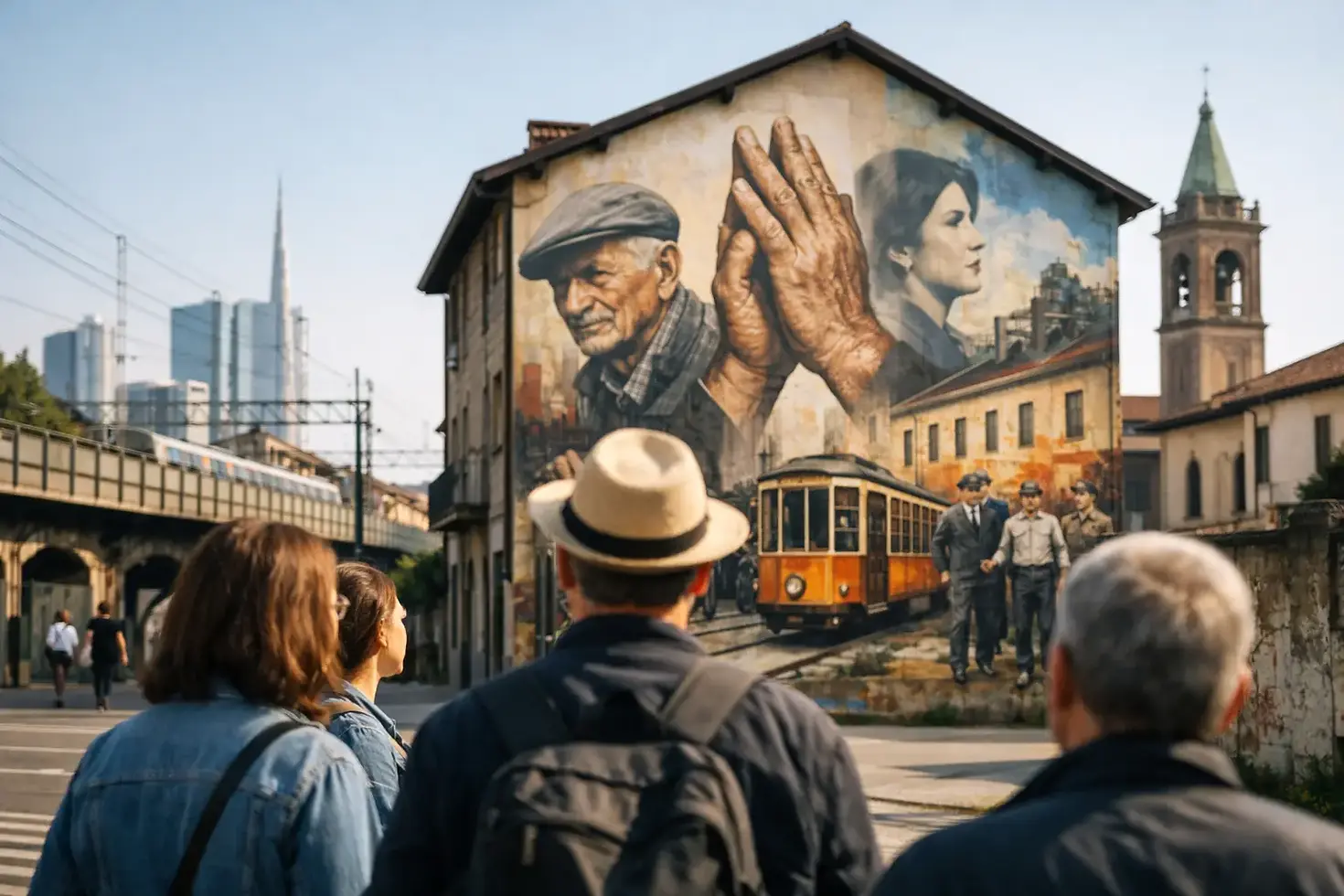
A faded factory wall becomes a page of history in Ortica. On an Ortica street art tour, Milan reveals a different kind of masterpiece: not one kept behind velvet ropes, but one encountered between rail lines, modest courtyards, workshops, and the daily rhythm of a lived-in neighborhood.
This is not the Milan of polished shop windows or landmark façades. Ortica, on the city’s eastern edge, asks for a slower gaze. Its monumental murals bring faces, choices, losses, and acts of civic courage into the open air. For travelers who want to understand Milan beyond its famous center, the experience is both visually striking and quietly moving.
Why an Ortica Street Art Tour Feels Different
Many street art districts are celebrated for color, scale, and photographic impact. Ortica has those qualities, but its language is more intimate. Here, murals often function as public remembrance. They speak of the Resistance, the struggle for democracy, labor, migration, women’s rights, sport, literature, and the people whose convictions helped shape modern Italy.
The neighborhood’s open-air project, widely known as Ortica Memoria, has transformed blank walls into a shared archive. Works created by the local artist collective Orticanoodles are not simply decorative interventions. Their large-scale stenciled portraits invite conversation about the past and about the responsibilities carried by the present.
That distinction changes the pace of a visit. An Ortica street art tour is less about collecting images and more about reading a city. The best moments often arise in the space between a mural and its setting: a historic industrial building, a quiet residential street, a train passing nearby. The geography gives each image a different resonance.
A Neighborhood Written in Layers
Ortica grew around rail infrastructure and industry, and it has retained a character that feels notably separate from central Milan. This is part of its appeal. The streets are not arranged as a theatrical promenade for visitors. They are the real backdrop of neighborhood life, with all the texture and occasional disorder that implies.
The murals emerge gradually. One may be visible from a distance, while another occupies the side of an ordinary building and becomes apparent only when you turn a corner. This element of surprise makes a guided walk particularly rewarding. Without context, it is easy to admire a portrait and miss the historical episode, the symbolic detail, or the reason that figure has been placed there.
Ortica is also a reminder that Milan has never been solely a city of fashion and finance. It is a city of workers, students, partisans, publishers, musicians, and families who arrived from elsewhere to build a future. Its street art offers a moving counterpoint to the grandeur of Milan’s museums and palaces: art made public, direct, and available to anyone willing to pause.
Portraits That Carry a Story
Some of the most powerful murals portray figures recognized across Italy for their moral and political courage. You may encounter references to the anti-fascist Resistance, to judges and activists who opposed organized crime, or to women who expanded the space of public life. Other works honor less universally familiar names, which is precisely why an informed narrative matters.
The visual style is instantly recognizable. Enormous faces are rendered with graphic precision, often in a limited palette punctuated by vivid color. Up close, the images reveal their stencil-based construction. From across the street, they take on the presence of monumental posters or old cinematic stills. The technique creates a compelling tension: an art form associated with immediacy is used to preserve memory.
Do not expect every mural to deliver an easy or cheerful message. Ortica’s beauty includes gravity. Stories of war, persecution, and social conflict appear alongside celebrations of freedom and creative life. For many visitors, this emotional range is what makes the neighborhood memorable long after the photographs have been sorted.
What a Well-Curated Visit Adds
Ortica can certainly be visited independently, particularly by confident travelers with time to wander. Yet a self-guided stroll comes with a trade-off. You may see the art, but not always the web of stories that connects individual murals to Milan, Italy, and the neighborhood itself.
A thoughtful guide can shape the walk into a coherent narrative rather than a sequence of stops. The difference lies in the details: why an artist chose a particular wall, what an image recalls, how the area changed from a working district into a living public gallery, and where to stand for the strongest view. The route can also be paced around personal interests, whether your focus is 20th-century history, visual culture, urban regeneration, or contemporary Milan.
For a private Made-to-Order experience, Ortica works beautifully as a focused cultural interlude or as part of a wider day in eastern Milan. It can be especially rewarding for small groups and families with older children, provided the conversation is tailored with care. Corporate guests may find it a refreshing alternative to conventional hospitality itineraries: a setting that invites dialogue rather than passive sightseeing.
MI EXPERIENCE approaches places like Ortica with the same attention given to a historic house museum or an after-hours cultural visit. The goal is not to rush through a checklist, but to create room for observation, connection, and a story that feels personal.
When to Go and How to Enjoy It Well
Because the murals are outdoors, daylight is essential. Morning and late afternoon usually offer the most pleasing light for photographs, with softer shadows and fewer harsh reflections. The district can feel especially evocative on a clear weekday, when its everyday rhythm is most visible, though the right timing depends on the route and your preferences.
Comfortable shoes are advisable. This is a walking experience through real streets rather than a compact museum circuit, and surfaces can be uneven in places. Bring water in warmer months, and consider a light layer in spring or fall. Milan’s weather can change quickly, while rain may make an open-air tour less comfortable even if the art remains visible.
There is another matter of etiquette that deserves attention. Ortica is not an outdoor theme park. Residents live beside these walls, and the murals belong to a shared neighborhood fabric. Keep voices considerate, avoid blocking entrances or driveways, and photograph people only with appropriate discretion. Respectful visitors help preserve the generous spirit that makes this public art possible.
Who Will Love Ortica Most
The experience is ideal for travelers drawn to art with a social conscience, for repeat visitors to Milan seeking a less familiar chapter, and for anyone interested in how cities choose to remember. It also suits guests who value substance over spectacle. The murals are undeniably photogenic, but their real value is in the questions they leave behind.
If your time in Milan is very limited and you have never seen the Duomo, the Last Supper, or the Brera district, Ortica may not be the first priority. It depends on what you want from the city. But for those with a few days, or for travelers returning to Milan with curiosity intact, it offers an exceptional change of perspective.
Beyond Street Art: A More Complete Milan
An Ortica visit pairs naturally with Milan’s broader cultural landscape. It can create a revealing contrast with the refined galleries of the city center, where art is framed, collected, and conserved. In Ortica, art is exposed to weather, time, conversation, and the gaze of passersby. Both settings matter. Together, they show how Milan moves between heritage and reinvention.
There is also something deeply Milanese about the neighborhood’s transformation. A former industrial quarter does not erase its past in order to become relevant. Instead, it uses its walls to acknowledge that past, giving it a vivid and contemporary form. The result feels neither nostalgic nor polished into anonymity. It feels inhabited.
Leave time after your walk for a quiet coffee or a meal elsewhere in the city, and let the images settle. You may find that the mural you remember most is not the largest one, but the face whose story changed the way you looked at Milan.
Commenti